What You Lose Either Way
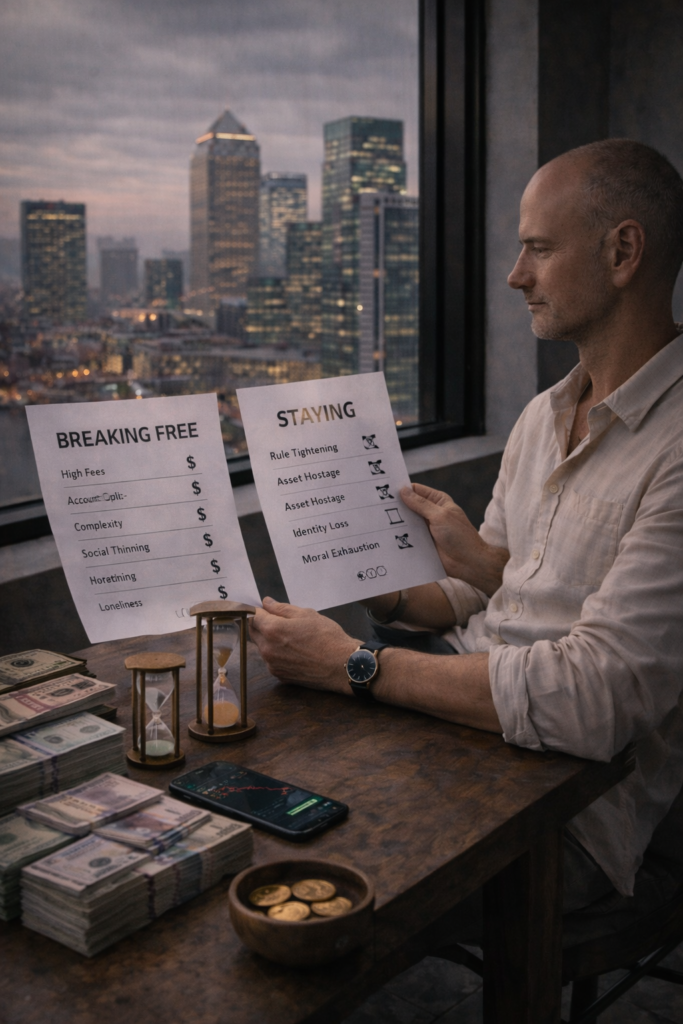
Every choice carries a cost.
What matters is whether the cost compounds against you.
Most men are paralysed not because they don’t want freedom,
but because they have never seen the costs written down cleanly.
This page exists to do exactly that.
No romance.
No fear theatre.
Just a ledger.
The Central Mistake
Most men compare:
- the cost of leaving (visible, immediate, uncomfortable)
against
- the cost of staying (invisible, deferred, normalised)
This is not a fair comparison.
The correct comparison is:
Which costs grow larger the longer I delay?
SIDE A — The Cost of Breaking Free
These costs are real.
They are paid up front.
Anyone who denies them is selling fantasy.
1. Financial Inefficiency
Breaking free is not optimised.
You will experience:
- duplicated accounts
- idle capital
- suboptimal tax positioning in the short term
- higher friction
You trade efficiency for resilience.
Anyone promising “perfect optimisation” alongside sovereignty is lying.
2. Complexity
Your life becomes harder before it becomes simpler.
You will manage:
- multiple jurisdictions
- inconsistent rules
- administrative overlap
- learning curves
This is the price of removing single points of failure.
Simplicity comes later — after architecture stabilises.
3. Social Thinning
Some relationships will weaken or disappear.
Not through conflict — through:
- distance
- asymmetry
- lack of shared reference points
You will stop being legible to people who stayed.
This is not cruelty.
It is divergence.
4. Loss of Status Signalling
Leaving removes familiar status markers:
- job titles
- addresses
- institutions
- social proof
You may feel smaller for a time.
This is temporary — but unavoidable.
Sovereignty begins when external validation stops mattering.
5. Loneliness (Early Phase)
There is a quiet stretch where:
- you are no longer embedded
- but not yet re-rooted
This phase is misinterpreted as failure.
It is not.
It is decompression.
6. Identity Discomfort
Old labels dissolve faster than new ones form.
You will not know how to answer:
“So what do you do?”
This is not a problem to solve quickly.
Rushing identity reconstruction is how men rebuild cages.
7. Self-Reliance Pressure
You absorb responsibility previously outsourced to:
- employers
- systems
- institutions
- routines
This creates pressure.
It also creates strength.
SIDE B — The Cost of Staying
These costs are less visible.
They are paid over time.
Most men never notice them until they are irreversible.
8. Option Decay
Every year of stillness:
- narrows exits
- increases entanglement
- deepens dependency
What feels like stability is often gradual lock-in.
Optionality does not remain neutral.
It erodes.
9. Rule Drift
Rules rarely change in your favour.
They:
- tighten
- expand scope
- reinterpret past behaviour
- add compliance layers
You don’t notice because change is incremental.
Until it isn’t.
10. Asset Hostage Risk
Assets kept inside one system are subject to:
- capital controls
- withdrawal limits
- freezes
- reclassification
Wealth without mobility is not wealth.
It is exposure.
11. Jurisdictional Leverage
The longer you stay:
- the more data accumulates
- the more obligations attach
- the more leverage exists
This leverage is invisible — until it is used.
12. Identity Calcification
The longer you remain:
- the harder it becomes to leave
- the more your identity ossifies around the system
At some point, exit no longer feels possible.
Not legally — psychologically.
13. Compressed Exit Risk
Delayed exits are rarely clean.
They happen:
- under pressure
- during stress events
- when options are reduced
Late exits cost more and preserve less.
14. Moral Exhaustion
Long-term misalignment creates:
- low-grade resentment
- fatigue
- cynicism
- quiet despair
This drains energy even when life appears “fine”.
Men often mistake this for aging.
It is not.
The Ledger Summary
Breaking Free costs:
- money
- simplicity
- familiarity
- early comfort
Staying costs:
- optionality
- leverage
- future flexibility
- exit timing
One set of costs is paid once.
The other compounds indefinitely.
The Non-Obvious Truth
The real cost is not financial.
It is timing.
Leaving early feels expensive because the danger is theoretical.
Staying feels cheap because the danger is deferred.
But deferred costs rarely remain small.
Final Entry
You are not choosing between:
- freedom and safety
You are choosing between:
- paying deliberately
- or being charged later under worse terms
There is no free path.
There is only the path whose costs you understand.